The Reciprocal Influence of Manet and Morisot
The contemporary art historical urge to "rehabilitate" marginalized figures often falls into the trap of asserting influence solely by proximity. The current exhibition "Manet & Morisot," hosted by the Cleveland Museum of Art, attempts to move beyond the traditional narrative that positions Berthe Morisot as a peripheral Impressionist within Edouard Manet’s orbit. While previous curatorial efforts, such as the Met’s 2023 "Manet/Degas," framed their subjects through the lens of rivalry, this exhibition opts for a conjunction. It seeks to elevate Morisot from a subject of Manet’s portraits to a conceptual peer who fundamentally altered the aesthetic trajectory of 19th-century modernism.
At its core, the exhibition faces a steep uphill climb against the archival weight of their biographical data. Their connection is well-documented: they met in 1868 while both were copying works at the Louvre, a shared habit of the period. Morisot later married Manet’s brother, Eugène, and served as the subject for at least 11 of Edouard’s portraits. The exhibition’s opening gallery feels somewhat obligated to address the gossip surrounding this relationship, specifically the "did they or didn’t they" narrative fueled by the intense focus of works like Berthe Morisot Reclining (1873). For the professional observer, this feels like a concession to broader audience expectations rather than an analytical necessity. However, once the exhibition pivots away from Morisot as a visual object, it gains significant critical traction.

The most compelling evidence for mutual exchange lies in the shared use of motifs that defined their transition into modernity. Curator Emily Beeny posits that Manet adapted Morisot’s depictions of children—specifically the figure with their back turned—as he moved toward the compositional innovations found in The Railway (1873). In Morisot’s View of Paris from the Trocadero (1871–1873), this turning-away motif acts as a subtle rebellion against the overt "gaze" of the era. Where Manet relied on the confrontational directness of his subjects to signal his modernity, Morisot leveraged concealment and the withholding of interiority. Her children are not merely subjects; they are boundaries, marking the limits of the viewer’s ability to possess the scene.
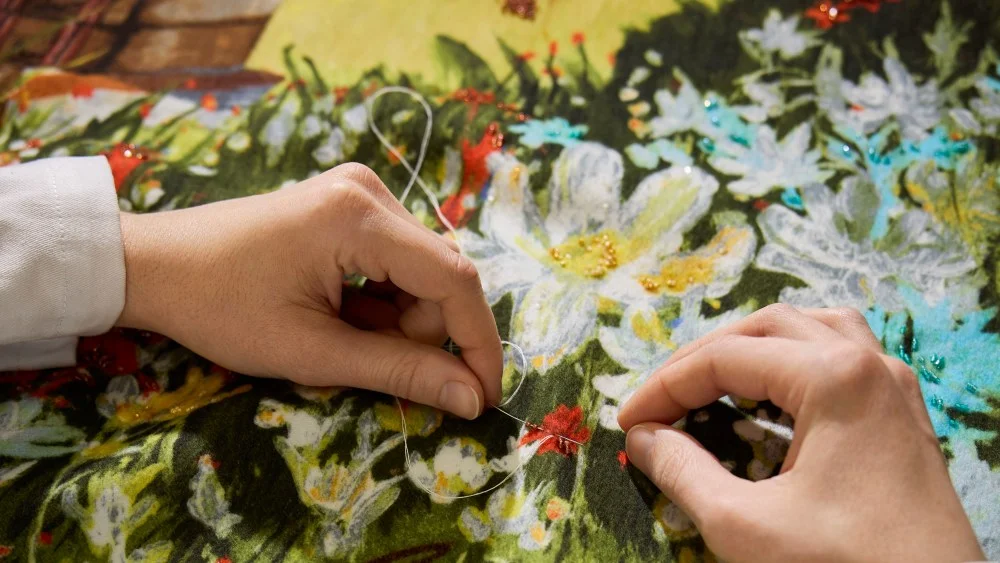
The exhibition also succeeds in repositioning "women’s work" within the technical constraints of the period. Morisot’s recurring interest in sewing and textile arts, exemplified by Paisie Sewing in the Garden at Bougival (1881), is frequently relegated to domestic iconography. Yet, the formal resonance here is undeniable. The rhythmic, repetitive nature of her brushstrokes mirrors the structural mechanics of embroidery. By treating the canvas as a site of textile labor, Morisot was not merely illustrating her environment; she was importing the materiality of craft into the high-status medium of painting. This is a crucial distinction that differentiates her technical approach from the more traditional studio methods Manet favored.
The exhibition’s final act—a bold 1885 self-portrait—showcases a Morisot who has fully shed the constraints of her milieu, wielding a frenetic, confident brushstroke that challenges the spectator directly. However, the curatorial framing here feels slightly retrograde. By insisting on placing this late-career breakthrough alongside Manet’s established canonical style, the exhibition inadvertently risks diminishing her singular contributions. There is a palpable tension between the desire to prove her "modernity" by aligning her with Manet and the reality that her most profound work—her exploration of privacy, domestic labor, and the non-confrontational gaze—exists in a category entirely separate from his.
For those tracking the evolution of revisionist art history, the takeaway is not that Morisot is as "important" as Manet, but that our historical criteria for importance remain tethered to patriarchal benchmarks. If we continue to seek validation for women artists through their proximity to the "father" of any movement, we ignore the formal innovations that developed entirely outside of those lineages. The future of this discourse shouldn't be about whether Morisot was as revolutionary as Manet, but how her rejection of his aggressive, modernizing gaze provides a more accurate map of the anxieties defining the late 19th century.