The contemporary short story is too often shackled to the "psychological assignment"—a predictable, character-driven architecture that prioritizes narrative resolution over the visceral mechanics of language. In her debut collection, Day Care, Nora Lange attempts to decouple the form from these familiar expectations, treating the page not as a vehicle for character study, but as a site of active, often unstable, experimentation.
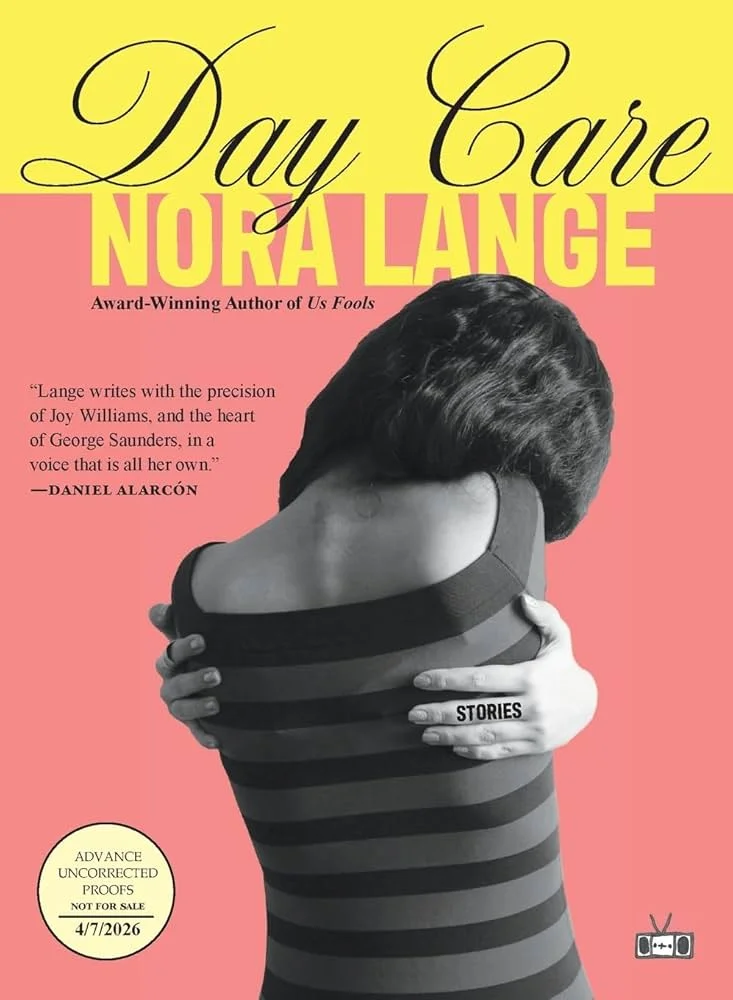
Lange’s approach to the short story—which she likens to a "snow globe"—is an exercise in containment. The analogy is instructive: by placing domestic or systemic realities inside a confined, artificial environment, she forces the reader to confront the friction between individual agency and external imposition. She frames stories like “Dog Star” or “Owls Yawn Too” as responses to the invisible pressures of policy, industry, and social hierarchy. These are not surrealist exercises for the sake of abstraction; they are tactical reconfigurations of reality designed to mirror the way power structures intrude upon the personal sphere.
The distinction between the novel and the short story is, for Lange, one of architectural endurance versus instantaneous impact. While she views the novel as a "roomier" space where a writer can afford to get lost, she approaches the short story as a highly compressed, "time-consuming" act of precision. It is closer to photography than architecture; the goal is to bring one specific point—a "daffodil teetering on a windowsill"—into razor-sharp focus, while letting the periphery bleed into abstraction. This skepticism toward narrative completeness serves as a hedge against the exhaustion of traditional tropes.
Much of the collection’s urgency stems from a persistent tension between survival and death—what Lange identifies as the twin poles of the human experience. Her prose does not shy away from the material reality of that tension. Drawing on her own life—the precarious economics of raising a child, the "unglamorous" reality of balancing labor with the act of writing—she argues that the modern state of precarity is not merely a backdrop for her stories but the primary catalyst for their creation. Motherhood, described here as a form of "time travel" and a "transhuman" state, informs this focus on circularity and the persistence of memory against forces that aim to erode it.
Lange’s technical methodology is overtly eclectic. She maintains a repository of "cutouts, emails, saved drafts, notebooks," treating the writing process as an act of osmotic absorption. One story in the collection was drafted on a mobile device while observing a stranger at a gym; another grew from a scrap of paper kept for over a decade. This reliance on the accidental encounter suggests a rejection of the "professionalized" writing process, which often favors polish over the raw, trembling images that defined her earlier creative workshops. Her skepticism toward the "facile psychological assignment" is matched by a commitment to what she calls "active psychosis meets regular therapy"—using language to interrogate the baffling, often illegible project of existing.
This is a stance of aggressive engagement. Lange views self-doubt as an encroachment of power, a deliberate erosion of the individual’s internal narrative. Consequently, her writing—the act of recording the minutiae of day-to-day survival—becomes a political reclamation of the self. If the external world is a blur of policy and interference, the story is the mechanism by which one holds the line. It is, as she notes, an effort to "legitimize" her own intuition against a world that demands a more conventional, easily digested form of legibility.
For the professional observer, Day Care is a reminder that the most compelling literary output often comes from writers who treat the story as a "problem to view" rather than a set piece to be resolved. Lange isn't interested in the neat wrap-up; she is interested in the stinging epiphany and the persistent, unanswered questions that follow. Her rejection of the "inherited, the familiar, the conventionally legible" isn't just an aesthetic choice; it’s an admission that the standard tools of contemporary fiction may no longer be sufficient for the task of describing a world that feels as though it is vanishing while we are still trying to read about it.
The collection serves as a case study for the value of constraint. By placing these stories in a "vestibule" of her own making, Lange successfully captures the specific, heightened anxiety of our current moment. Readers expecting traditional arcs will find themselves disoriented, which is exactly the point. The book’s success is found in the moments where the narrative pulse mimics the erratic, non-linear experience of modern life. Her next move—likely to touch on the "transhuman" complexities of motherhood as a form of time travel—suggests that she will continue to push at the seams of what the short story can contain. For now, the takeaway is clear: if the world is to be recorded, it should be done with a refusal to look away, even when the pieces of the puzzle do not fit.
The post A Snow Globe Theory of the Short Story appeared first on Electric Literature.