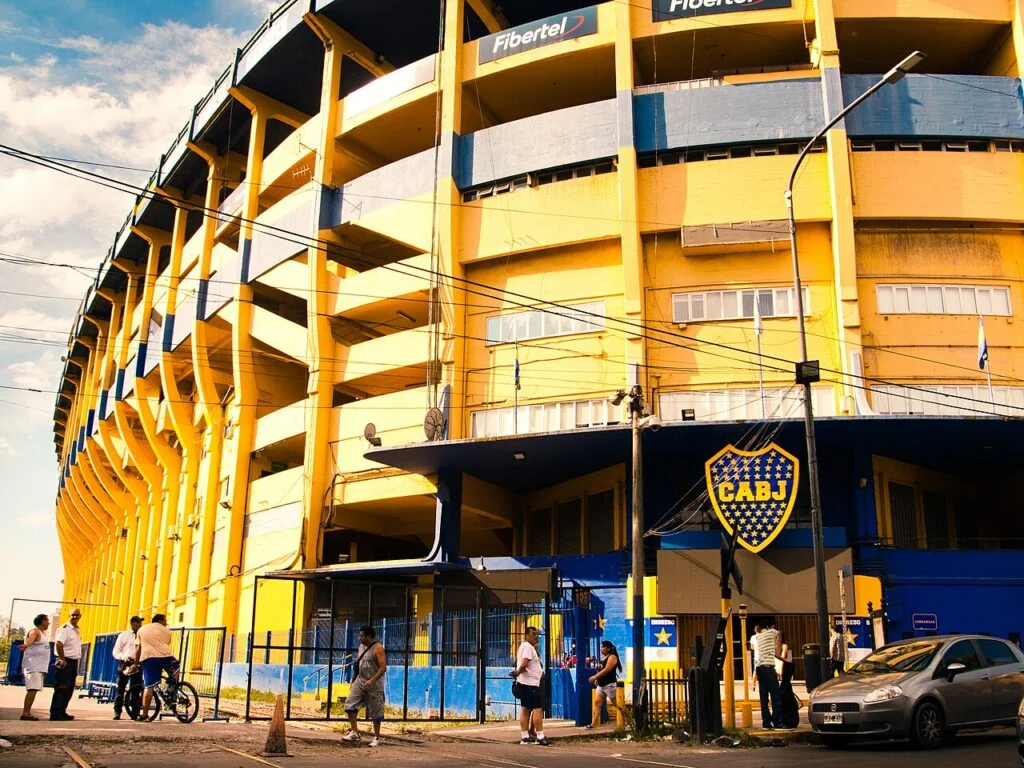
Photograph by Hernán Piñera, via Wikimedia Commons. Licensed under CC BY-SA 2.0.
For the uninitiated, the Clásico is marketed as a transcendent footballing holiday. The reality, however, is a repetitive cycle of expectation routinely crushed by the weight of its own mythology. Fans treat these matches like children expecting a miracle from a department store Santa, hoping that a ninety-minute clash will somehow justify a lifetime of fanatical devotion.
My own pilgrimage to the May 4, 2008, Superclásico between Boca Juniors and River Plate was the culmination of thirty-four years of deferred gratification. Having previously visited River’s Estadio Monumental, I found myself drawn to La Bombonera—a structural anomaly so singular that it warrants study not just as an arena, but as a sociological specimen. The fame of Boca’s ground is indisputable; it draws tourists like the Mona Lisa. Yet, stripped of its reputation, one has to wonder: is the hysteria surrounding this specific pitch actually rooted in footballing excellence, or is it merely a well-maintained performance of aggression?
On the journey from Ezeiza airport, my taxi driver—a transplant from Rosario—offered a dissenting view. With the disdain only a local can muster, he dismissed the Buenos Aires rivalry as a media construct. To him, the true theater of cruelty wasn’t here; it was in the historic bad blood between his hometown clubs, Newell’s Old Boys (“the Lepers”) and Rosario Central (“the Swine”). He spoke of family betrayals and sectarian hatred with the gravity of a theologian, ultimately concluding that while God might be omnipresent, he reserves his most punishing tricks for Buenos Aires.
This atmosphere of pre-match dread is a staple of the experience. Weeks earlier in Madrid, Jorge Valdano, a veteran of these derbies, recounted his first experience at La Bombonera. As he prepared in the locker room, the floor beneath him began to oscillate. A senior teammate didn't offer a tactical briefing; he simply provided a reality check: “It’s not you, pibe; it’s the stadium.” The arena is designed to make the visitor feel as if the structure itself is undergoing a nervous breakdown.
Martín Caparrós, in his definitive text Boquita, identifies this as the birth of the “twelfth man” archetype. In Argentina, the fans don't just watch; they attempt to bend reality through sheer lung power, rhythmic insults, and a collective, suffocating intensity. It is an environment where the game is less a sport and more a state of siege. If you are looking for an objective analysis of the match quality, look elsewhere—the Superclásico is a test of emotional endurance, not an exhibition of technical prowess.
The romanticism of Ernesto Lazzatti—the archetype of a player who dedicated his life to a single crest without casting glances toward European wealth—has effectively evaporated. Modern Argentine football is a transient business. As one local taxi driver dryly noted, there is a pervasive cynicism regarding homecoming stars like Juan Sebastián Verón or Juan Román Riquelme, who are dismissed as either aging relics or eccentric outliers. It is a harsh assessment, but one that underscores the transactional nature of the modern sport: if you have the talent, you are expected to export it.
My own experiences covering the game, such as working alongside Carlos Bianchi during the 2006 World Cup, reveal the depth of these personal entanglements. Bianchi, a legendary Boca Juniors coach, once took a call from Riquelme during a commercial break, treating the player's need for emotional validation with the gravitas of a patriarch. Riquelme, a man who required total psychological immersion to perform, found the clinical, opera-house atmosphere of Barcelona’s Camp Nou hostile compared to the raw, visceral pressure of La Bombonera. He was a product of a theater that demands passion, not decorum.
This creates a striking paradox: the players treat their careers as a permanent commute, while the supporters remain the only constant. In Argentina, fans find utility in the friction of the sport, whereas elsewhere, such as in Mexico, the narrative often relies on the deferral of success. Watching the game at La Bombonera alongside writers like Juan José Becerra—author of Grasa—one realizes that the reporting here isn't about crafting ornate descriptions for a mundane event. It is about witnessing an immediate, hardboiled reality that renders flowery prose redundant. The stadium functions as a living organism; it vibrates with a vertigo that demands presence rather than analysis.
This transition from the habitual postponement of glory to the impatient, survivalist intensity of the Argentine stands is the ultimate challenge for the foreign journalist. You are forced to abandon your reliance on adjectives and confront the brute force of the pitch itself.
This text is an excerpt from The Game at the End of the World, translated by Francisco Cantú and due for release via Restless Books this May.
Juan Villoro is a Mexico City-based journalist and author whose work has been featured in Reforma, The New York Times, El País, and El Mercurio. A laureate of the 2018 Manuel Rojas Prize, he has held academic appointments at institutions including Yale, Princeton, Stanford, and the Autonomous Metropolitan University. Francisco Cantú, author of The Line Becomes a River, is a writer and translator who has received a 2018 Los Angeles Times Book Prize and a 2017 Whiting Award. His work has appeared in The New Yorker, Granta, Guernica, and VQR.



.jpg)