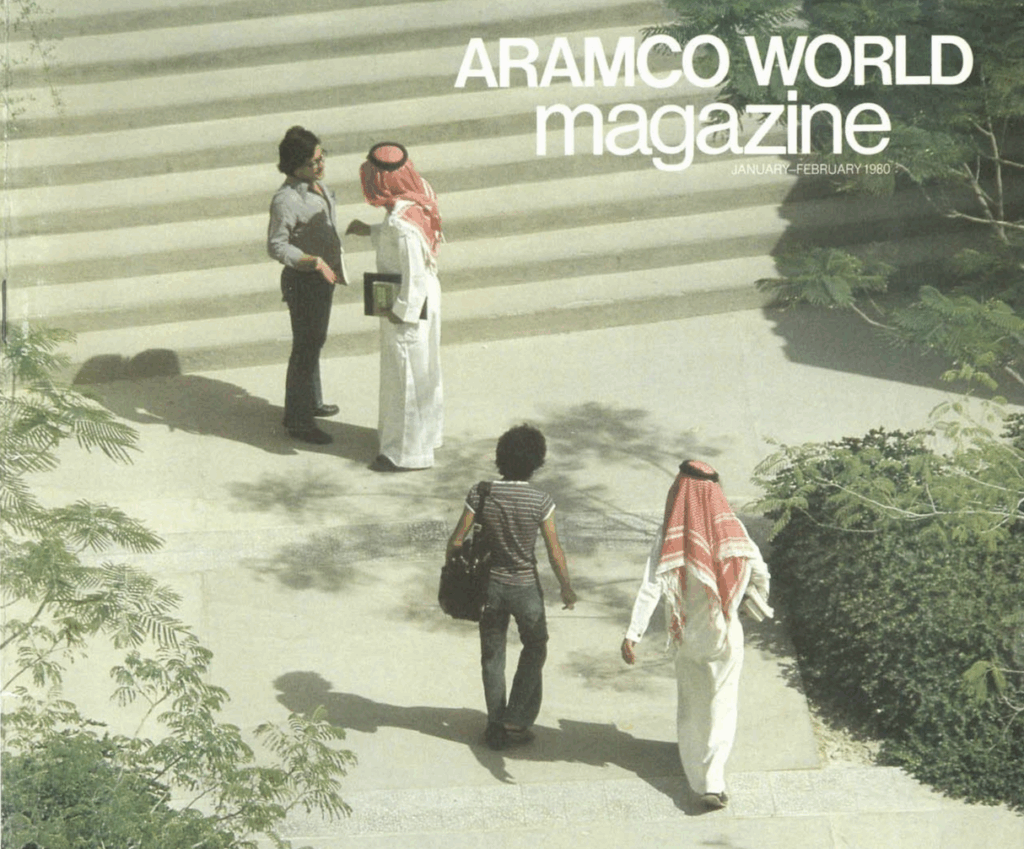
Aramco World, January–February 1980 cover, via Wikimedia Commons. Public domain.
Consider the oddity of a 2001 issue of Aramco World, the flagship publication of the Saudi Arabian Oil Company’s American subsidiary. Inside, a contributor details the exploits of Count Wacław Rzewuski, a nineteenth-century Polish aristocrat who refashioned himself as a sheik to secure Arabian horses for his nation’s cavalry. It is a niche, historically curious piece of long-form journalism that feels entirely untethered from the geopolitical anxieties of the early twenty-first century.
This dissonance is the magazine’s hallmark. Aramco World occupies a strange, parallel space in the media ecosystem: it is a high-quality, humanist, and intellectually rigorous publication funded by a fossil-fuel giant that historically prioritized image management over investigative depth. While the magazine’s guidelines strictly prohibit coverage of political, business, or religious controversy—a policy that has notably kept the publication silent on the devastation in Gaza—it simultaneously pursues a form of cosmopolitan storytelling that feels radical in its refusal to dehumanize its subjects.
Following the 9/11 attacks, this ethos was tested. Rather than pivoting to the standard, fearful narratives dominating American newsrooms—the “WHY THEY HATE US” brand of reporting that fueled post-9/11 Islamophobia—the magazine quietly published a four-page photo essay documenting a candlelight vigil held by Arab Americans in Brooklyn. By centering human stories, like that of a thirteen-year-old Yemeni immigrant or the grace of oud virtuoso Simon Shaheen, Aramco World offered a counter-narrative to the prevailing partisan climate. It did not offer political commentary; it simply asserted the existence of a complex, multifaceted Arab-American experience.
The publication originated in 1949 as an internal corporate newsletter, a vehicle for sharing mundane news about company personnel—wedding announcements, office shifts, and the like. As former editor William Tracy noted in a 2010 interview with Bidoun, the magazine was born out of an early, desperate need to sanitize the company’s image for an American public increasingly suspicious of its business practices. The goal was to replace the reality of industrial strife at the Dhahran compound with a sanitized aesthetic of cross-cultural harmony, often relying on staged photography of smiling workers.
Over the decades, however, Aramco World shed its strictly parochial skin. It evolved into a bizarre, charming hybrid: a blend of the classical general-interest magazine style and the hyper-specific, almanac-like trivia of a specialized academic journal. Today, from its base in Texas, it distributes bimonthly dispatches that move with total indifference to the typical boundaries of corporate PR. One finds investigative deep dives into the history of ninth-century Iraqi cookbooks, the transit of Habsburg-era coins across East Africa, or the intricacies of folk music in Albania.
There is an inherent irony in this output. It is a project funded by a massive oil interest, yet its editorial curiosity is often profound and entirely detached from the company’s bottom line. Whether one views it as a sophisticated, long-game branding exercise or a genuinely autonomous enclave of cultural journalism, Aramco World persists as a curiosity. It is a publication that acknowledges the constraints of its parent company while carving out a quiet, stubborn insistence on the beauty of the world it claims to survey.
The golden era of Aramco World feels increasingly like a rearview mirror. Since the 2023 shift toward a "digital-first" model, the publication’s aesthetic quality has dipped, and its editorial focus has drifted into tired territory—evidenced by tepid, buzzword-heavy dispatches on AI in Arabic. Yet, the publication remains a free resource that justifies its existence through sheer curiosity. The annual Gregorian calendar alone, with its meticulous curation of textiles—ranging from Turkmen horse blankets to Moroccan wool—serves as a physical manifestation of the magazine’s core thesis: the Islamic world is not a sequestered monolith, but a permeable, interconnected expanse.
This rejection of "walled garden" narratives extends to the magazine’s willingness to explore pre-Islamic history. By analyzing subjects like Hammurabi’s Code or the evolution of chess, Aramco World sidesteps both the Salafi "age of ignorance" narrative and Western attempts to frame Islam as an isolated civilizational silo. A prime example is the 2021 cover story, “The Quest for Blue,” which traces the history of pigments from Bronze Age Central Asia to medieval Venice. It treats historical chemistry with the urgency of a contemporary auction house scoop, effectively grounding the "analytical category" of Islam in the material, lived history that scholar Ahmed championed in his 2015 work, What is Islam?
My own fascination with the region has never been a clean, linear pursuit. It began with the Taj Mahal—a monument that, while aesthetically overwhelming, presents a jarring, macabre origin story. That inherent tension between the beauty of the pietra dura and the reality of the structure's purpose is a recurring theme in the magazine’s extensive coverage of the site, spanning from 1968 critiques to 2024 studies on the Raj-era depictions of the tomb.
Ultimately, Aramco World serves as a necessary, if lightweight, antidote to the "Oil Encounter." As Amitav Ghosh noted, American discourse surrounding oil usually descends into a binary of "Problems" needing "Solutions," fueled by suspicion and geopolitical anxiety. By simply refusing to participate in this rhetoric of entrapment, the magazine acts as the Oil Encounter’s most peculiar, and perhaps most vital, byproduct. It is a slow-burn project that treats Islamic societies not as a source of hysteria, but as a diverse historical tapestry, quietly working against the grain of typical petro-industrial propaganda.
Krithika Varagur is the author of The Call: Inside the Global Saudi Religious Project and an editor of The Drift and Equator.