The Antigone Obsession: Why Modern Theater is Cannibalizing the Myth
The current theatrical season in New York has seen an unusual glut of productions centered on Sophocles’s Antigone. From high-profile Broadway reinterpretations like Robert Icke’s Oedipus to a flurry of off-off-Broadway experiments, the Theban rebel is currently ubiquitous. Yet, looking across these disparate stagings—which range from neon-drenched fascist dystopias to metatheatrical philosophical seminars—one trend stands out: contemporary directors and playwrights seem remarkably uncomfortable with the original text. They are not merely performing the play; they are aggressively laundering it through modern political anxieties.
This trend reveals a disconnect between the source material’s classical rigor and the current creative impulse to prioritize thematic "relevance" over dramatic cohesion. When Virginia Woolf described Electra as a figure “tightly bound,” she recognized the structural constraints that give Greek tragedy its terrifying momentum. Modern directors, conversely, view Antigone as a flexible template, treating her as a cipher for whatever contemporary cause is currently being championed. In the Flea’s recent production, directed by Alex Pepperman, the setting is shifted to a 2030 neo-fascist United States, explicitly drawing lines between Sophocles’s Creon and an imagined 47th President. The original dramatic tension—born of divine law versus human decree—is flattened into a straightforward protest narrative.
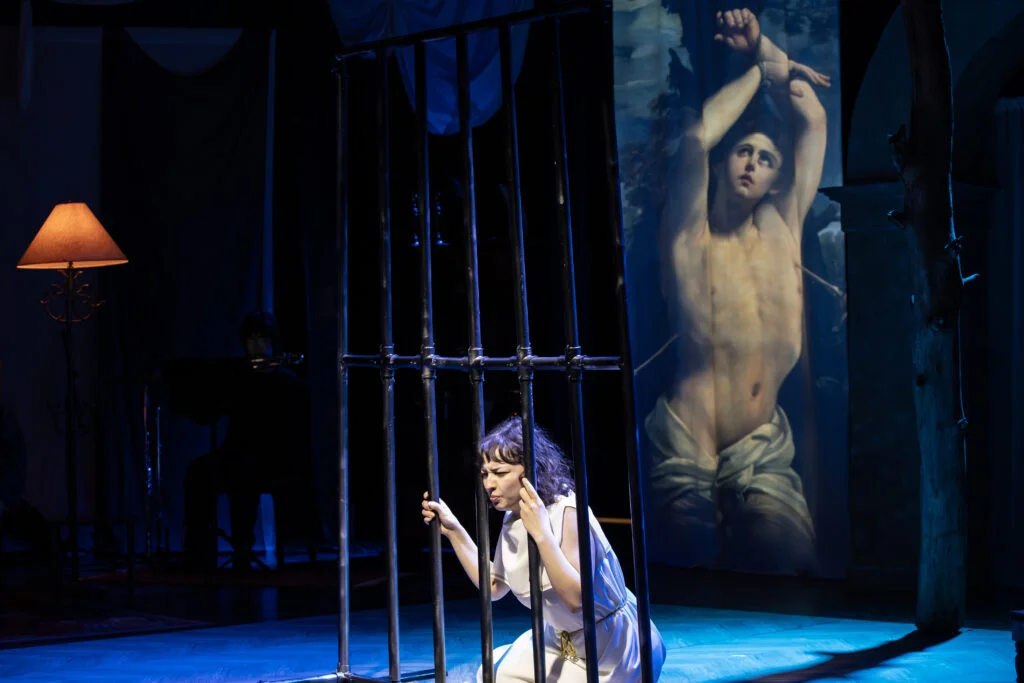
Alessandra Lopez in Antigone in Analysis, March 19, 2026. Photograph by Marina Levitskaya.
The danger of this approach is most evident in the Public Theater’s Antigone (This Play I Read in High School). By self-consciously acknowledging the play’s high-school-curriculum status, the production attempts a defensive posture against accusations of irrelevance. However, in pivoting the central conflict from the burial of a brother to the termination of an unwanted pregnancy, the play loses its intellectual anchor. Sophocles’s Antigone acts out of a cold, inevitable duty to the dead; Anna Ziegler’s protagonist acts out of a contemporary struggle for bodily autonomy. While the latter is a significant social issue, grafting it onto the Sophoclean scaffolding feels opportunistic. The classical structure becomes merely ornamental, struggling to accommodate a narrative that is fundamentally uninterested in the original's core dilemma: the brutal cost of absolute conviction.
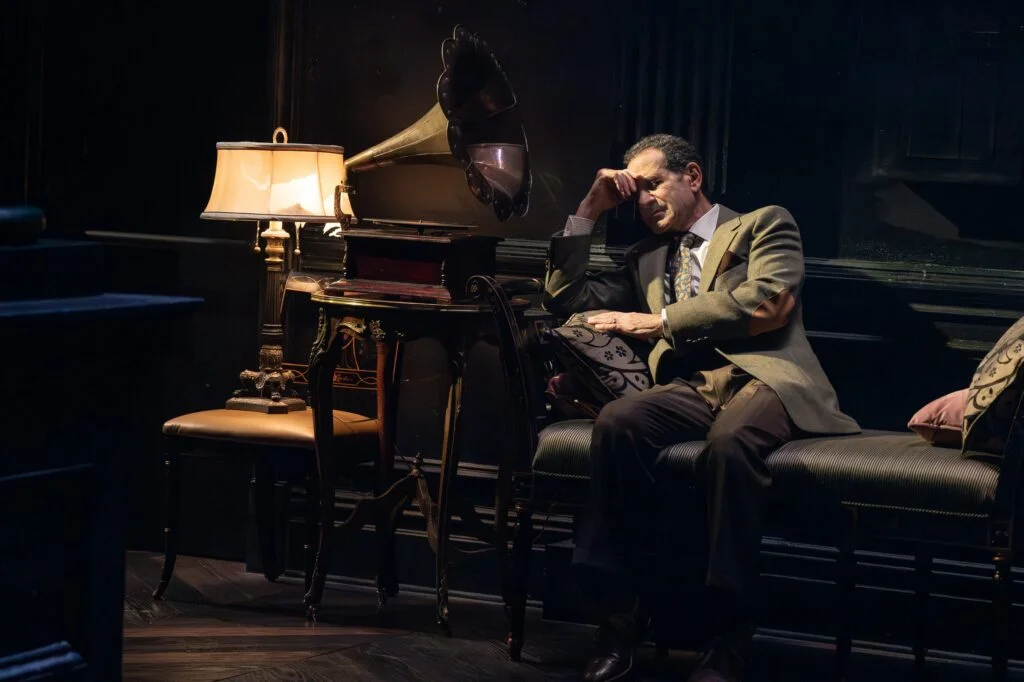
Tony Shalhoub in the world premiere production of ANTIGONE (THIS PLAY I READ IN HIGH SCHOOL) by Anna Ziegler and directed by Tyne Rafaeli. Photograph by Joan Marcus.
Even more detached is Alexander Zeldin’s The Other Place, currently streaming via National Theatre at Home. Zeldin strips away the mythic dressing entirely, focusing on a domestic psychodrama involving a niece, an uncle, and the ashes of a suicide. By removing the political stakes, Zeldin inadvertently exposes the fragility of his characters' motivations. Without the backdrop of Theban law, the incestuous overtones—while transgressive—lack the weight of the original curse. The result is a work that confuses discomfort for profundity; the play’s "radical" departures lead the protagonist to an emotional collapse that feels arbitrary rather than earned.
The most egregious example of this "one thought too many" phenomenon is Barbara Barclay’s Antigone in Analysis. By literally populating the stage with philosophers like Hegel, Lacan, and Judith Butler to deconstruct the action in real-time, the play collapses under the weight of its own theory. Rather than allowing the audience to engage with the text, the production insists on mediating every beat of the performance through academic critique. It is a work that suffers from an acute lack of confidence in the source material’s ability to stand on its own, opting instead to turn the stage into a lecture hall where characters debate the very meaning of the scene they are currently inhabiting.
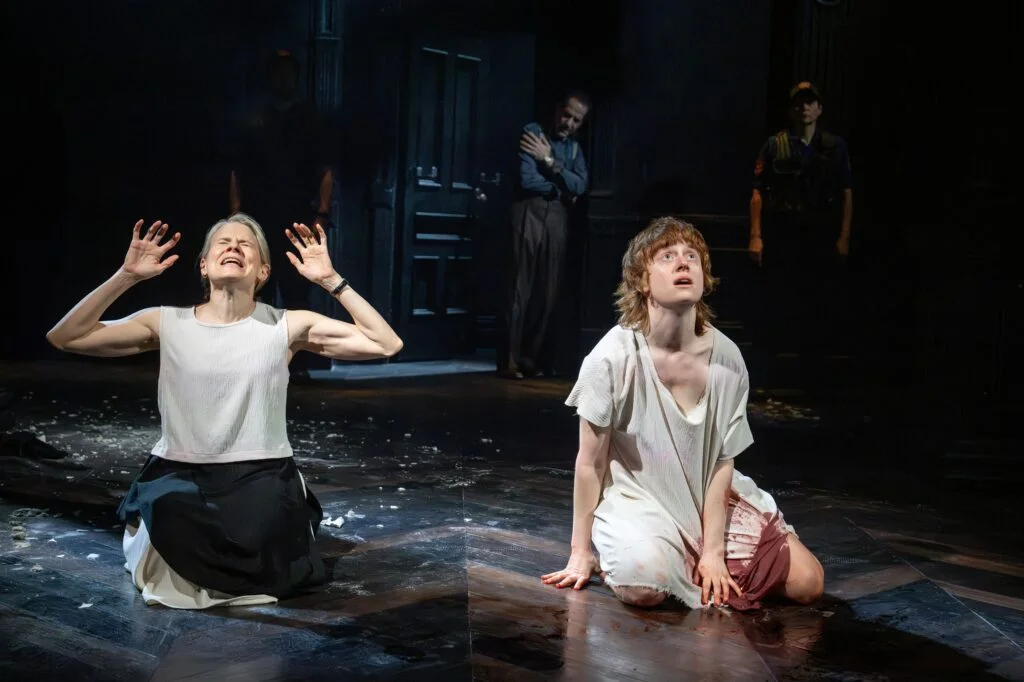
Celia Keenan-Bolger and Susannah Perkins in the world premiere production of ANTIGONE (THIS PLAY I READ IN HIGH SCHOOL) by Anna Ziegler and directed by Tyne Rafaeli. Photograph by Joan Marcus.
Perhaps the most salient takeaway comes from the philosopher Gregor Moder, who suggests in his upcoming book Antigone as Political Philosophy that the character’s true endurance lies in the "substantive emptiness" of her deed. The original play works precisely because the motivation for Antigone’s rebellion is absolute and, to a modern ear, somewhat incomprehensible. It is not a platform for an ideology, but a rupture in the fabric of civic order.
The industry would do well to recognize that updating a classic does not mean upgrading it. The more these productions attempt to force Antigone into the rigid boxes of contemporary political discourse, the more they hollow out the very thing that makes the myth resilient. If theater-makers continue to use the character as a mirror for their own reflexive concerns, they risk losing the tragic power that has kept her on stage for two millennia. The "hungry whispering" that our past is still with us should be allowed to speak, rather than being constantly shouted down by the playwright's contemporary agenda.