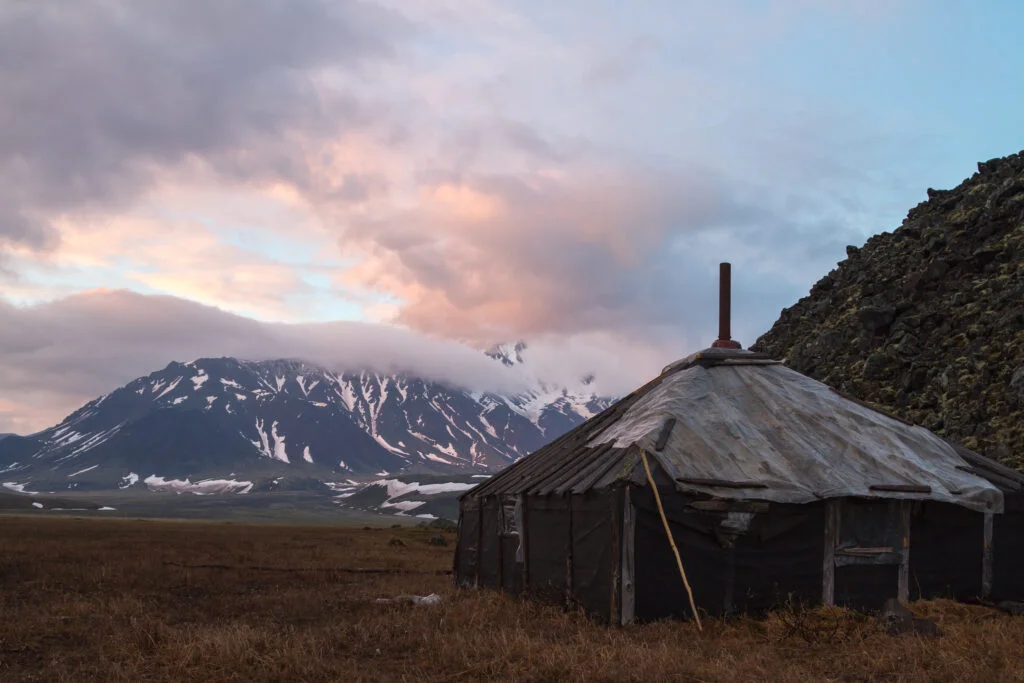
Reindeer herders’ house in Bystrinsky Nature Park, Kamchatka. Photograph by NadezhdaKhaustova, via Wikimedia Commons. Licensed under CC BY-SA 4.0.
Pushing through a dense, snow-choked canopy in Kamchatka, I struggled to match the pace of my companions, Dasho and Clint. Every few steps, the deep, unforgiving powder swallowed my legs to the thigh. As the spruce woods thinned and the wind began to howl, I pulled my earflaps tight and demanded a destination. Dasho’s reply was brief, promising something that justified the grueling trek.
We emerged into a clearing, and there it sat: an incongruous, oversized white sphere mounted on a steel gantry nearly ten meters tall. It was a sterile, technological monolith in the middle of a wilderness. When I pressed for an explanation, Dasho deadpanned that it was America’s way of ensuring the Russians couldn't reclaim Alaska. His companion, Clint, confirmed the farce: the sphere was a Cold War-era surveillance radar, still operational and manned by American officials who emerged only long enough to greet us before retreating back into their metal shell.
The existence of these installations is not unique. Clint claimed a network of these "soccer balls" dots indigenous villages across both Alaska and, conversely, Siberia. The strategic logic is cynical but clear: tucking high-tech surveillance into remote, indigenous-populated areas provides a convenient cloak of obscurity, shielded from the prying eyes of tourists or journalists who might question the lingering specter of the Cold War. As we stood in the biting wind, Dasho stared at the radar and mused on its counterparts across the strait. He wondered if those on the other side—the people he imagines living lives mirrored to his own—can see their own version of this hardware from their kitchen windows.
For an anthropologist, these are the moments that disrupt the rhythm of fieldwork—the sudden "lightning strikes" that shift a research focus toward something deeper. Dasho’s curiosity about the lives of those on the other side of the Bering Strait became mine, too. It evolved into a compulsion to bridge a divide that has been splintered by three centuries of colonial history, state antagonism, and geographical separation.
The rhythm of life at the Icha hunting base is dictated less by the clock than by the erratic cadence of the radio. These hunting camps and the nomadic reindeer herders rely on an analog broadcast network to bridge the vast, unforgiving tundra. I watched Ilo coordinate logistical lifelines—flour, sugar, tobacco, and coffee—with an unseen operator, treating the transmitter as a vital umbilical cord to the village of Esso. When he finally signed off after confirming a bleak long-range forecast, the transition from high-stakes supply logistics to the isolation of the rain-swept wilderness was seamless and immediate.
Living under Ilo’s roof has blurred the lines between anthropological observation and raw survival. Our days are punctuated by the mundane ritual of cleaning salmon for the dog, apana, and ourselves, intercut with surreal philosophical debates about planetary rotation and the geography of distant nations. While I struggle to reconcile my own impatience with these long, circular conversations, I am acutely aware of the fragility of this frontier. We are physically trapped by weather, yet mentally traversing the gap between the Evens' reality and the modern world.
This period of forced stillness is a window into a lifestyle that refuses to be codified by outside expectations. The logistical supply chain managed via radio frequency is not merely commerce; it is the infrastructure of existence in a place where the concept of a "border" is defined by a river, not a map. As Nastassja Martin notes in her upcoming work, East of Dreams (forthcoming from New York Review Books this May), these connections—to the land, to the radio, and to each other—are all that prevent total erasure in the subarctic tundra.
For those interested in the wider scope of Martin’s work on Indigenous resistance and human habitability, her academic tenure at the University of Paris 1/Sorbonne and her documentary projects like Tvaian provide a deeper look at the subjects featured here. Meanwhile, the translation of this narrative into English—handled by Sophie R. Lewis—preserves the specific tension between the narrator's urban skepticism and the practical, grounded reality of the Icha hunters.
The uncertainty remains: the radio is silent for now, the rain persists, and we continue to wait for a passage across the river. In a region where even the sun seems to defy standard orientation, waiting is not an obstacle—it is the work itself.